By Jack Sutton
I love skateboarding. The breeze through my hair, the tactile snap of the board, and the gentle hum from the wheels spinning are therapeutic to me. Unfortunately, skating is dangerous. So, I’ve naturally had my share of encounters with the cold, unforgiving concrete of downtown Toronto. From these experiences, I’ve found an appreciation for something more than ice bags and bandages. Skating has led me to a greater understanding of perseverance and what it means to try again.
Falling hurts—a lot. Yet, there’s an odd satisfaction to it; Not satisfaction in the fall itself, but rather the triumph. It’s weirdly refreshing to get off the ground and step back on the thing that took you down.
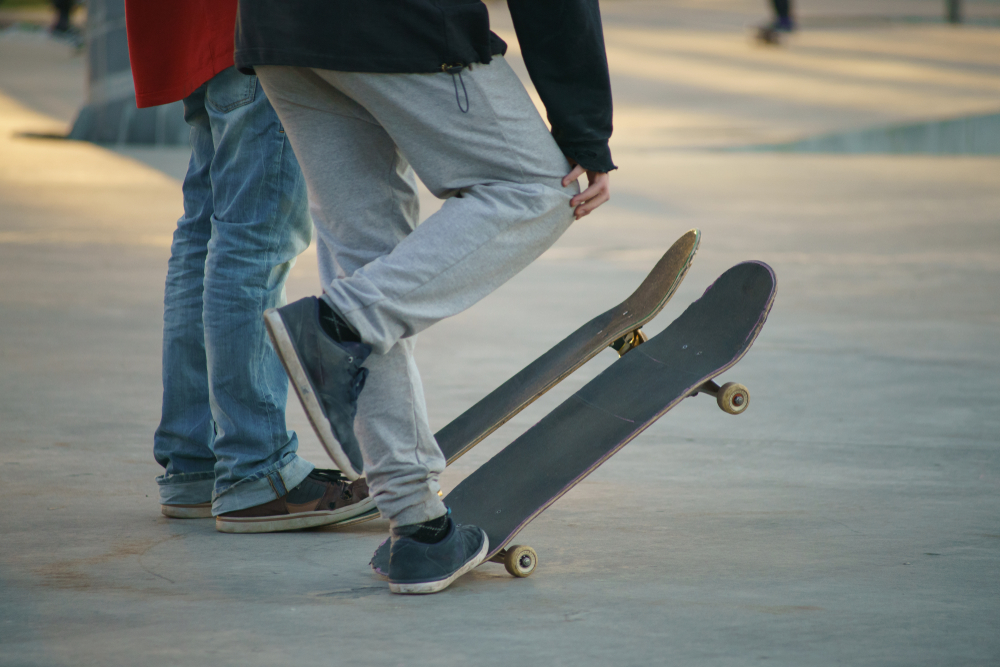
Last April, I was skating around the University of Toronto campus with a buddy. We were skating the varsity 4-block, an iconic spot in Toronto skate culture. To clarify, 4-block is skate slang for four large ledges, arranged like a set of stairs. Essentially, I tried to hit the ledges like a gap, clearing all 4 of them before landing. I must’ve hyped myself up for 10 minutes before committing to the feat. When I finally did, my wheel caught a pebble right at the top of the first ledge. The tiny stone sent me tumbling down the set. I distinctly remember the impact, immediately sore and disoriented. My left hip and leg were aching at a harsh and constant rate. I can only describe it as a cacophony of pain. As I lay there, my friend pointed out that I was bleeding. I looked at over at my left arm to find an open cut on my forearm. It wasn’t terribly deep, but it was certainly bleeding quite a bit. After a few minutes, I slowly rose and kicked my board into my hand. On my way up the steps, I spotted the pebble that took me down. I flicked it out of the way and set up for round two. I ran towards the set and jumped on my board as I threw it down. As I approached at a good speed, the sweet snap of the board followed. This time, I cleared the set, and it was off to Tim’s to treat my wound.
That moment made me realize something important. Though the cheer from my friend was encouraging, I felt that my struggle was completely internal. I was at war with myself, and it would have been wrong to walk away from the 4-block.
In times of hardship, my mother tells me that I can only go up from here. She first used the saying a couple of years ago, when I was much younger. At that age, I wasn’t yet accustomed to the harsh realities of life. I hadn’t experienced real sadness, disappointment or grief. For this reason, I wasn’t able to sympathize with the saying. As I entered adolescence, I began to face more pebbles, stones, and even boulders. I had experiences that knocked me down both physically and emotionally. For one, I finally had to deal with loss and illness of those around me, which hurt more than any fall could. It was then that my mother’s saying started to resonate with me.
When I started skating, I often thought of the apparent connection to my mother’s saying. Every time I’ve fallen while skating, I’ve tried again, so I started to wonder, why not do the same in the real world? Why not rise in the face of adversity? Why not find satisfaction in perseverance? For the past year, I’ve been living by this mantra. There’s often no way to avoid trauma, but it can certainly be overcome. When I’m knocked down, the only thought on my mind is to stand up and try again, because every defeat comes with imminent victory. I believe in grit and unrelenting perseverance.
 The Howlander