By Jacob Buchan
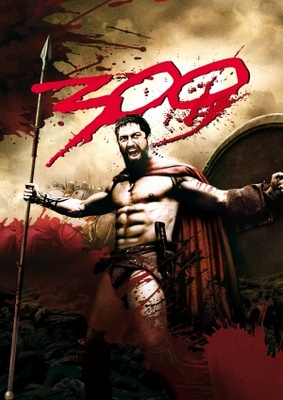
“This is a whole heap of style tinged with just a smidgen of substance.” Empire writer Will Lawrence summed up Zack Snyder’s historical action film 300 with one quippy line in his criticism of the film. 300 is a feature-length film following the life of Spartan king Leonidas and his endeavors to halt the Persian invasion of Ancient Greece in 480-479 BCE. The movie attempts to document what is known as The Battle of Thermopylae, the legend detailing how 300 Spartan warriors defended greater Greece against some 100,000-150,00 Persian soldiers. The film is far from a masterpiece: rife with inaccuracy, poor cinematic choice, and a farcical approach to the historical-action film genre, it is a tedious two hours of tiresome motion picture.
Initially, the film starts with promise. Most viewers are expecting epically gory and visceral violence, and they have come to the right place. One of the early scenes, depicting an interaction between king Leonidas and a Persian messenger, establishes the coming conflict. As tension within the scene grows and Leodias delivers the famous “This is Sparta!” line, casting the messenger into the local Spartan chasm, the movie introduces its prominent feature: slow-motion. The use of this time-distorting special effect is enjoyable initially but quickly becomes tired, overused, and downright irritating as every scene of the film, from Leodias’s backstory in the opening sequence to every confrontation at Thermopylae, uses slow-motion without restraint. The film relies heavily on its special effects. The motivation for such is understandable; these computer-generated images were just becoming prominent in the industry, and a melee-action movie is a perfect place to use the new cinematic tools. But combined with voice alteration with the Persian king Xerxes, strange facial-modifications among many of the Persian warriors, and CGI monsters, the digital influence is overwhelming.
From another cinematic standpoint, the entire film is shot with a sepia tone filter, which creates a strangely surreal tone throughout the film. This becomes prominent in the borrowed shots from Ridley Scott’s Gladiator, which depict our classical-era protagonist prowling the wheat fields near his home with his wife and son. Whether these shots were intended as an allusion to the other well-known historical action film or to pay homage to it, the blatant repetition and similar framing come across as visual plagiarism.
Nitpicking aside, the greatest detriment to the movie is its distinct lack of cohesion. The movie centers on the battle between Leonidas and his Spartans against the vast Persian hordes. The focus on the action is what the audience is looking for, and while the movie does provide a profusion of bloodshed, it includes under-explained subplots that make the narrative hard to follow. Before reaching Thermopylae, Leodias’s assortment of warriors marches across the Greek countryside, and upon arrival, see the massive Persian fleet. Immediately after, the fleet is destroyed by a raging storm, battering the Persian ship against the shore while the Spartans dance and celebrate. The audience is left somewhat confused, wondering if now the battle is over before it truly began. Another convoluted subplot is about the troubles with Leodias’s wife, the queen of Sparta, Gorgo, and her attempts to rally support for the embattled king. Gorgo has to deal with an antagonist turncoat-assemblyman named Theron, the interactions resulting in an unnecessary rape scene. The brutal addition confuses the plot further.
A significant factor is the quality of historical information. The film was not unpopular; it grossed $456.1 million worldwide, and the inaccuracy presented creates a false historical image in viewers’ minds. That being said, the film does right on a number of plot points: a local greek turncoat (portrayed as the physically disabled Spartan outcast) did reveal to the Persians a secret route to outmaneuver the Greek defense; this then caused the Spartan’s allies to flee, whereas the Spartans would fight to the death. While the film creates fictional dramatic interactions between Leonidas and the Persian king Xerxes, Xerxes himself was at the Battle of Thermopylae, leading the Persian army personally. One of Leondias’s troops, Dilios, did leave the battle before the Spartans were destroyed to spread the word of their heroic sacrifice. While Dilios did not lead a counter-attack later down the line (as shown as the concluding scene of the film), his actions did show Leonidas as a martyr and cause the Greeks to rally and push back the Persian invaders.
Some details of exact accuracy were overlooked in the film, but one can assume that the discrepancies were necessary to create a more compelling storyline. This includes the film’s portrayal of Leonidas’s motley assortment of allies, depicting some small number of men from an unnamed local city-state lead by the character Daxos. In reality, the Spartans were accompanied by some 7,000 soldiers from neighbouring city-states including Thebes, Thespiae, and other local communities. When many of this number fled after the Persians were able to encircle them, the 300 Spartans remained with many Thespians and Thebans to fight to the death.
The film has some major discrepancies regarding historical accuracy, and its credibility suffers from these. A significant flaw is a video-game-level feel the battle scenes have, as the waves of Persians continually get bigger and badder: war rhinos, elephants, and human mutants are launched at the staunch Spartan defenders. This presentation is completely false: exotic beasts of war were not used greatly outside of their native environments. The Persians did not possess humanoid giants, one such shown to be set loose on the bulwark of embattled Greeks. “The Immortals,” elite Persian warriors shown to go toe-to-toe with the Spartans, did fight at Thermopylae, but were human; the film shows them to be another sort of inhuman entity as one of their number loses its face-mask.
The greatest inaccuracy in the film is the notion of the Persians being malicious slavers. This is false. The Persian empire was Zorastrian: this ancient religion, founded in Mesopotamia, was based on the dualistic perception of good and evil, and spiritual balance. One of the chief elements of Zoroastrianism was the fact that slavery was outlawed. The Persian empire did not have institutionalized slavery, was widely accepting of other religious practices and cultures, and prisoners of war were treated humanely throughout their conquests. The Greeks, by contrast, were slavers. Slavery was widespread in what is often viewed to be the cultural center of Ancient Greece, Athens. The film builds an image of the noble Spartan defenders and outright evil Persian invaders when in reality, the Persian empire stands as one of the more humanely principled ancient nations.
In short, the film is a convoluted mess. The cinematography is poor, slow-motion dominates the screen, the plot arc is hard to follow, and the film presents ridiculous inaccuracies regarding the actual events. 300 is a prime example of an historical blockbuster film perpetuating myths and polluting the historical image within the public eye. When seeking a film either for historical information or visual entertainment, 300 should be put out of sight, and out of mind.
 The Howlander