By Adrian Rigby
This summer I paddled for 25 days in Labrador and Quebec on the Moisie River. After 25 days of routine, our group was skilled and organized enough that we managed to create plenty of free time. In the city. my life is usually chaos, and making time for reading is not one of my priorities. Out in the wilderness, this changed. One of my favorite activities was to immerse myself in nature, sit on a rock down by the river, and just read. I am not sure why, if it was the book, the environment, or both.
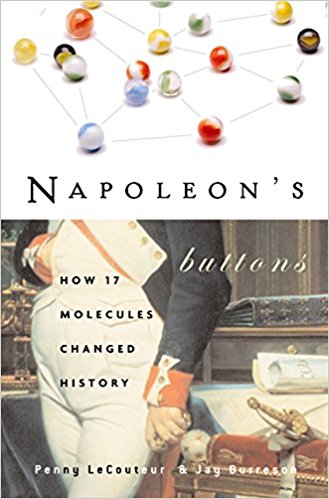
Penny Le Couteur’s Napoleon’s Buttons combines two of the things I find most interesting: history and science. The book’s seventeen chapters are each about a different molecule that changed history. What makes this book so entertaining is not just the content, but the writing. Even the title shows the spirit and clever nature of the writers. In 1812 when Napoleon invaded Russia, due to an early onset of winter, Napoleon was defeated. Many historians have tried to theorize exactly why Napoleon was defeated. One of the leading theories was that Napoleon used tin buttons, which, in the cold, changed shape. This caused the men in the army to drop their guns in order to hold their coats together. When they finally engaged in combat, they were slaughtered. This now seems unlikely, but it perfectly captures the concept of the book.
My favorite part of the book was the chapter on ascorbic acid (Vitamin C). It follows the same format as the other chapters. It begins with an anecdote, except instead of just one anecdote, the author chooses to show two contrasting anecdotes. The first is the voyage of Magellan who attempted to find a strait through South America and then circumnavigate the globe. Although he eventually did find a strait through the southern South America (named Magellan’s Strait in his memory), Magellan’s crew was reduced to just seventeen by the time they returned to Spain. That seventeen did not include Magellan, as he died in a skirmish with natives in Indonesia, due to his crew’s weakened state. Magellan was a smart man and a great leader, but he neglected one thing that had already been proven. Without ascorbic acid in your diet, you develop scurvy, which can weaken and kill a crew on a ship. That neglect would be his downfall.
Magellan’s voyage, although famous, was not an isolated incident. In fact, despite multiple scientists publishing papers on the relationship between consumption of ascorbic acid and scurvy, most captains ignored their advice. That was until Captain Cook observed with his own eyes a change in the number of men with scurvy due to a new diet. Being somewhat organized and obsessive in nature allowed Cook to systematically ration out ascorbic acid to men in every rank, including himself. This made the men on his ship listen to his instruction as they watched the other ships on their voyage in Australia suffer. Cook was rapidly promoted until the British began using this method on all their ships, by including bringing limes and lime juice in the sailors’ diet, eventually giving members of the British navy the nickname “Limeys.”
 The Howlander